Our mission is to learn as much as possible about earthquake, volcanic, and earth surface processes while enjoying the journey along the way. Our ultimate hope is to learn things that can help mitigate these potential hazards and contribute towards sustainable development of society.
Machine learning applications in geophysics
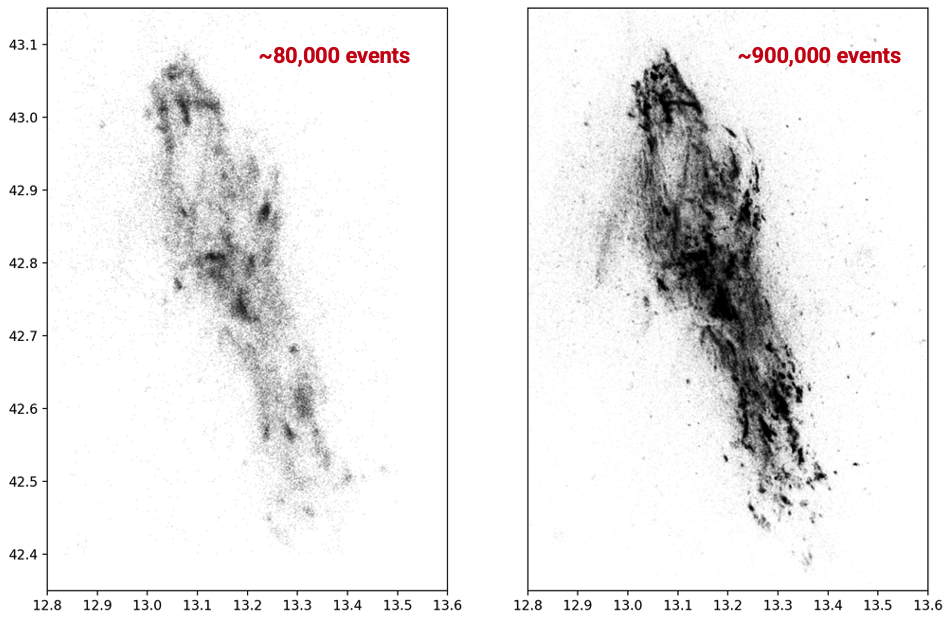
Earthquake catalog produced using traditional (left) vs machine-learning-based workflow (right).
We have applied machine learning to identify seismic signals precursory to eruptions [Yuan et al., SRL 2019; Wang et al., GRL 2024], improve detection of different types of seismic events [Cheng et al., SRL 2023; Zhong and Tan, GRL 2024; Wang et al., SRL 2024], as well as produce high-resolution earthquake catalogs to map fault structures and study earthquake interactions [Tan et al., TSR 2021], foreshock sequences [Liu et al., EPSL 2025], and swarms [Liu et al., Geology 2024], including along oceanic faults [Liu and Tan, GJI 2025].
How faults respond to stress changes
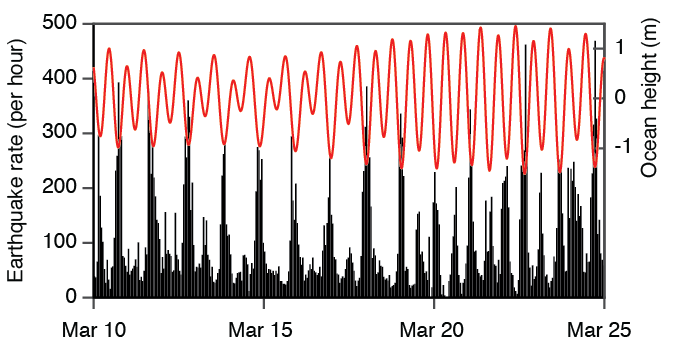
Number of earthquakes per hour in comparison with ocean tides.
We have examined how earthquake rate [Tan et al., GRL 2018] and frequency-magnitude distribution [Tan et al., EPSL 2019] vary with tidal stress to probe how earthquakes nucleate and constrain the frictional property of natural faults [Scholz et al., Nature Communications 2019]. We have also investigated how the dynamic triggering of earthquakes by teleseismic waves relate to permeability changes [Barkat et al., EPSL 2024] as well as how reservoir [Barkat et al., SRL 2022; 2024] and landslide-dammed lakes [Zhang et al., Nature Communications 2024] can trigger earthquakes.
Dynamics of volcanic systems
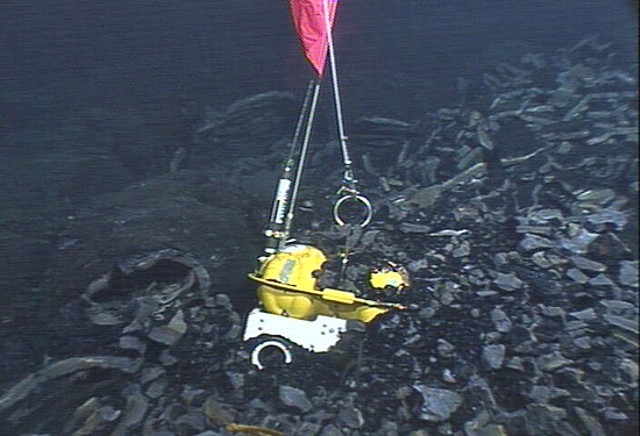
Ocean-bottom seismometer (OBS) trapped in lava flow. Watch how a remotely operated vehicle rescued one of them here [Image courtesy of WHOI/NSF].
Most submarine eruptions go undetected despite accounting for the majority of Earth’s volcanism. By analyzing OBS data, we have used the spatiotemporal evolution of microearthquakes [Wilcock et al., Science 2016; Waldhauser et al., JGR 2020], mixed-frequency earthquakes [Wang et al., GRL 2024], tremors [Zhu et al., Geology 2026], lava-related seismo-acoustic events [Tan et al., Nature 2016; Wang et al., Science Advances 2025], and seismic velocity changes [Lee et al., GRL 2024] to probe various magmatic processes and characterize the dynamics of submarine eruptions. We have also quantified how different types of earthquakes relate to magmatic and volcanic processes along the Aleutian subduction zone [Song et al., GRL 2023; Song and Tan, JGR 2025] and developed a deep-learning model that can detect both volcano-tectonic and long-period earthquakes [Zhong and Tan, GRL 2024].

Moment-duration scaling: Comparison between San Andreas slow events (dots) and proposed scaling for regular (green bar) and slow (blue bar) earthquakes.
Low-frequency/long-period earthquakes
Through statistical modelling, we have quantified the clustering properties of low-frequency earthquakes to infer the scaling properties of slow-slip events. We seek to understand why faults can slip over a wide range of velocities and reveal the dynamics governing transient fault slips [Tan and Marsan, Science Advances 2020]. We have also applied machine learning to improve detection of long-period earthquakes at volcanic regions [Zhong and Tan, GRL 2024] and are investigating their underlying source processes and utility for tracking magma/fluid movement [Song et al., Nature Communications 2026] and forecasting eruptions [Song et al., GRL 2023; Song and Tan, JGR 2025].
Earth surface processes

Recently, we started leveraging seismic methods to quantify the dynamics of large landslides [Ho et al., Landslides 2025], dam breaches, and outburst floods [Zhang et al., JGR 2024]. We also made the surprising discovery that landslide hazard cascades, which risk is escalating due to climate change and urbanization, can trigger earthquakes [Zhang et al., Nature Communications 2024].
 Yen Joe Tan (陈衍佐)